Chapter 1 of 4
The Rhythm
Vision, Build, Deploy, Refine, Delegate, Resume — the pattern behind every build.
From thousands of real building sessions, a rhythm emerged. Not a methodology — a rhythm. Like music, it has patterns you can feel but shouldn't over-formalize.
Vision → Build → Deploy → Refine → Delegate → Resume
1. Vision: paint the destination
Start loose. You're not writing a spec — you're painting a picture.
“I want to build a website where people can share AI-generated React components. Like a gallery. Clean, minimal, easy to browse.”
Notice what's not there: no tech stack, no database schema, no component hierarchy. Just the destination.
Why this works: Claude fills ambiguity with competence. When you describe the destination, Claude chooses a reasonable route. When you describe the route, Claude follows it even if it's a bad one.
2. Build: let it happen
After the vision, Claude starts building. Your job is to watch, not direct.
Read the output. See what Claude chose. If it's reasonable, let it continue. If something's wrong, speak up — but give it a chance.
# Good: course correction
"The header is too tall. Shrink it."

# Bad: premature takeover
"Stop. Let me specify exactly what each component should look like."
3. Deploy: put it on the internet
Deploy early, even when it's incomplete.
Deploy this to Vercel
Why? Because looking at something on a real URL changes how you see it. Issues that are invisible in development become obvious on your phone. And having a live link lets you share progress with others.
Deploy early. Deploy often. It's free and reversible.
Real projects built with this workflow

Source Library
An open-access library of 1,900+ translated historical texts across Latin, Arabic, and Hebrew — built through AI-assisted translation at a scale no human team could match.
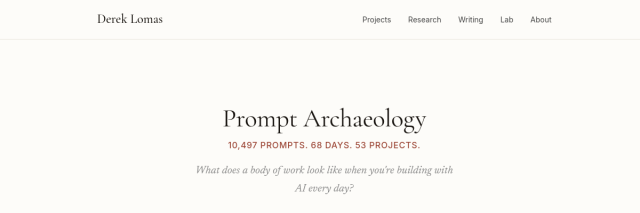
Prompt Archaeology
10,497 prompts from 68 days of Claude Code usage, extracted and visualized to reveal patterns in real vibe coding sessions.
4. Refine: iterate with vibes
This is where the magic happens. Small, fast adjustments:
"Darker"
"More breathing room"
"The text is hard to read"
"Mobile is broken"
"Too busy. Simplify."
Notice: these are feelings, not specifications. “Darker” doesn't specify a hex code. “More breathing room” doesn't specify padding values. You're describing the experience you want, and Claude translates that into code.
~The terse prompt style
5. Delegate: hand over the wheel
At some point, you have enough shared context that you can give Claude larger tasks:
"Work through the remaining todos"
"Handle the responsive design for all pages"
"Add error handling everywhere it's missing"
This is the Delegation pattern. It works when context is rich. It fails when context is thin. If you just started a session, don't delegate — build context first.
6. Resume: pick up tomorrow
Sessions end. Context gets compressed or cleared. When you come back:
“Where were we...”
Or look at your handoff notes, if you saved them:
“Continue from @.claude/handoffs/2026-03-01-project.md”
The resume step is the least glamorous but most important for long projects. Good session hygiene — compact at 75%, save handoffs, commit before ending — makes resuming painless.
Chapter 1 of 4